Learning the Quran is an important part of Islamic education for many Muslim families. Today, students can learn Quran reading, recitation and Tajweed from home through online lessons.
But what are online Quran classes, how do they work, and are they suitable for children and beginners?
Online Quran classes allow students to connect with a Quran teacher through the internet instead of travelling to a mosque, Islamic centre or classroom. These lessons can help children, adults and beginners develop their Quran reading skills with guidance from a teacher.
In this guide, we will explain how online Quran classes work, what students can learn, what equipment they need and how parents can choose a suitable learning programme.
What Are Online Quran Classes?
Online Quran classes are lessons conducted through the internet where students learn Quran reading, recitation, pronunciation and other Islamic subjects with a teacher.
Students usually attend lessons through a video call using a computer, laptop, tablet or smartphone.
Unlike recorded videos, live online Quran classes allow students to interact with their teacher during the lesson. The teacher can listen to their recitation, explain difficult words and provide feedback.
Depending on the course and student’s learning level, online Quran classes may include:
- Arabic letters and pronunciation
- Noorani Qaida
- Quran reading for beginners
- Quran recitation
- Tajweed rules
- Quran memorisation or Hifz
- Quranic Arabic
- Basic Islamic studies courses
Online Quran learning is available for children, adults, beginners and students who want to improve their existing recitation skills.
How Do Online Quran Classes Work?
Online Quran classes follow a learning process that allows students to study from home while receiving guidance from a teacher.
The exact lesson structure depends on the academy, course and student’s current ability.
1. Choose a Suitable Quran Course
The first step is to select a course that matches the student’s learning goals.
For example:
- Beginners may start with Arabic letters and Noorani Qaida.
- Children who can already read may work on Quran fluency.
- Students who want to improve pronunciation may study Tajweed.
- Learners interested in memorisation may choose Hifz.
Starting at the right level can make Quran learning easier and more comfortable.
2. Attend the Online Lesson
Students join their scheduled class using an internet-connected device.
The teacher explains the lesson, listens to the student’s reading and provides guidance throughout the session.
Depending on the teaching format, lessons may be one-to-one or conducted in a group.
3. Practise Quran Reading
Students practise what they have learned during the lesson.
This may include reading Arabic letters, revising previous lessons, practising Quranic words or reviewing Tajweed rules.
Regular practice between lessons can help students become more familiar with the material.
4. Receive Teacher Feedback
The teacher listens to the student’s recitation and identifies areas that need further practice.
Students can ask questions and receive guidance on difficult letters, words or reading rules.
Parents may also discuss their child’s progress with the teacher when appropriate.
What Do Students Learn in Online Quran Classes?
Online Quran classes can cover different subjects depending on the student’s age, learning level and goals.
Noorani Qaida
Noorani Qaida is commonly used to introduce beginners to Arabic letters, pronunciation and basic reading rules.
It can help children and adults develop the foundation needed for Quran reading.
Quran Reading
Quran reading lessons help students recognise Arabic words and read Quranic verses.
Beginners may start with simple reading exercises before progressing to longer passages.
Tajweed
Tajweed refers to the rules that guide correct Quran recitation.
Students learn how to pronounce Arabic letters correctly and apply recitation rules when reading the Quran.
Quran Memorisation
Some online Quran programmes offer Hifz lessons for students who want to memorise Quranic verses or chapters.
Memorisation involves learning new portions and revising previously memorised material.
Quranic Arabic
Quranic Arabic lessons may help students understand Arabic vocabulary, sentence structures and the meanings of Quranic words.
The course level depends on the student’s existing Arabic knowledge.
What Are the Benefits of Online Quran Classes?
Online Quran learning offers practical advantages for families and students.
1. Learn Quran From Home
Students can attend lessons without travelling to a mosque, Islamic centre or classroom.
This can be useful for families who live far from local Quran learning facilities or have busy schedules.
2. Convenient Learning for UK Families
Parents often need to organise Quran learning around school, homework, work and family commitments.
Online lessons can reduce travel time and may offer scheduling options that suit different routines.
However, available timings depend on the academy and teacher.
3. Access to Teachers Beyond Your Local Area
Online learning allows students to connect with Quran teachers outside their immediate neighbourhood.
This may give parents more options when choosing a teacher who suits their child’s learning needs.
4. Support for Different Learning Levels
Online Quran programmes may offer courses for complete beginners, children learning Arabic letters and students who want to improve their recitation.
Choosing a course that matches the learner’s current ability is important.
5. Teacher Feedback and Guidance
Live lessons allow students to read or recite while the teacher listens.
The teacher can identify mistakes, explain difficult concepts and suggest areas for further practice.
6. Learning in a Familiar Environment
Some children feel more comfortable learning from home.
A familiar environment may help them participate in lessons, especially when they are new to Quran learning.
However, parents should consider their child’s ability to focus during online lessons.
Are Online Quran Classes Suitable for Children?
Online Quran classes can be suitable for children when the course matches their age, learning level and attention span.
Parents should consider several factors before choosing online lessons.
The child’s learning level: A beginner may need Arabic letter recognition and Noorani Qaida, while another child may already be ready for Quran reading or Tajweed.
The teacher’s approach: Children often benefit from clear explanations, patience and age-appropriate lessons.
The learning environment: A quiet room with minimal distractions can help children focus.
Parental support: Younger children may need help joining lessons, setting up equipment and following their learning routine.
The lesson schedule: Quran lessons should fit comfortably around school, homework and other activities.
Parents should discuss their child’s needs with the academy before enrolling.
Are Online Quran Classes Suitable for Beginners?
Yes, online Quran classes can be suitable for students who are starting from scratch.
Beginners may start by learning:
- Arabic letters
- Letter sounds and pronunciation
- Basic Arabic reading
- Noorani Qaida
- Simple Quran reading exercises
Previous Arabic knowledge may not be necessary for a suitable beginner course.
The important thing is to start with a programme that matches the learner’s current ability.
Adults who did not learn Quran reading during childhood can also explore beginner lessons at a comfortable pace.
What Do You Need for Online Quran Classes?
Getting started with online Quran learning is usually straightforward.
Most students need:
Equipment | Purpose |
Laptop, tablet or smartphone | To join the online lesson |
Stable internet connection | To communicate with the teacher |
Microphone and speakers or headphones | To hear and recite clearly |
Quiet learning space | To reduce distractions |
Quran or learning material | To follow the lesson |
Parents should check the academy’s technical requirements before the first class.
For younger children, a laptop or tablet placed at a suitable height may make it easier to see the teacher and learning material.
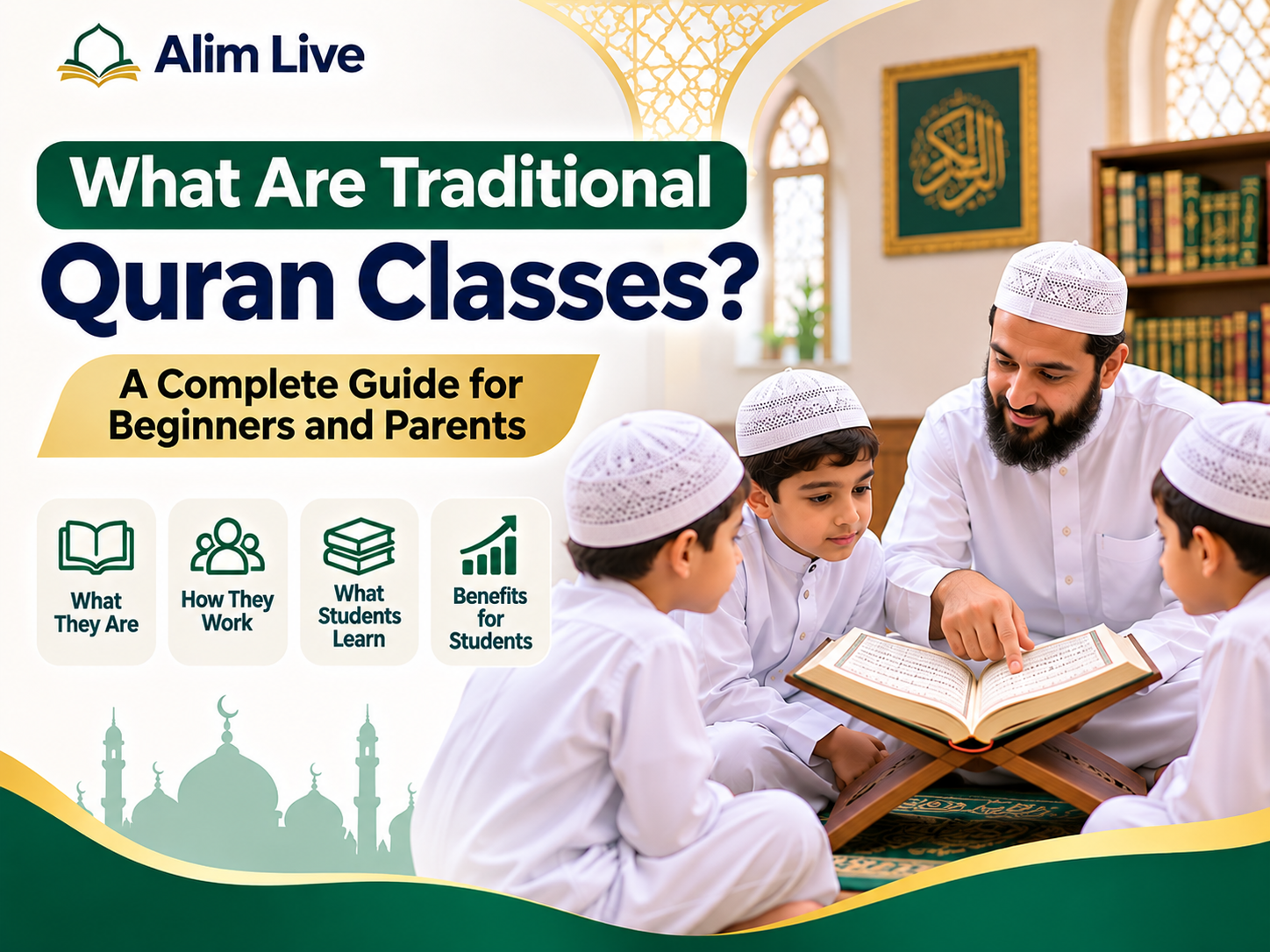
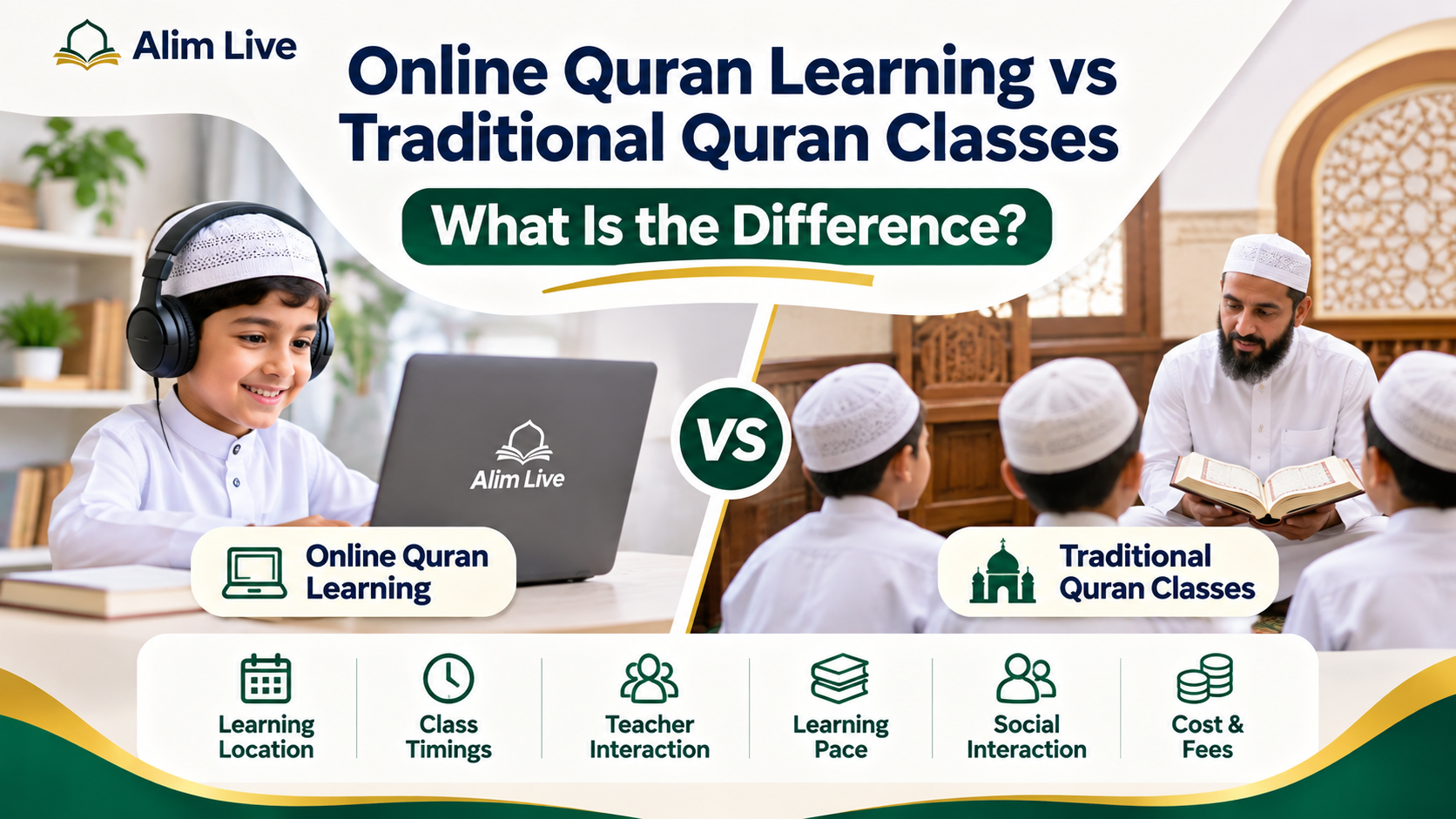
Online Quran Classes vs Traditional Quran Classes
Both online and traditional Quran classes can support Quran learning.
The right option depends on the student’s needs, preferred learning environment and family circumstances.
Online Quran Classes | Traditional Quran Classes |
Lessons take place online | Lessons usually take place in person |
Students can learn from home | Students travel to a mosque or learning centre |
Scheduling options may be more flexible | Timings depend on the local centre |
Students interact through video calls | Students interact face-to-face |
Access to teachers beyond the local area | Access often depends on local availability |
Online learning may suit families who need flexibility or have limited local options.
Traditional classes may suit students who prefer face-to-face interaction and a community learning environment.
Neither format is automatically better for every student. Parents should choose the option that supports their child’s learning needs.
How Can Parents Choose the Right Online Quran Classes?
Choosing a suitable Quran learning programme is an important decision for parents.
Before enrolling, consider the following points.
Check the Course Content
Make sure the programme covers the subjects your child needs.
For example, beginners may need Noorani Qaida, while children who already read Quran may benefit from Tajweed lessons.
Ask About the Teacher
Parents should understand the teacher’s Quran education, teaching experience and approach to working with children.
Ask how the teacher corrects mistakes and supports students who need additional practice.
Understand the Lesson Structure
Find out how lessons are organised, whether students receive revision tasks and how progress is discussed.
Consider the Learning Schedule
Choose a schedule that fits comfortably around school, work and family commitments.
A consistent and realistic timetable may be easier to maintain than an overly demanding routine.
Ask About Trial Classes
A trial lesson can help parents understand the teaching approach and decide whether the programme is suitable.
Use the opportunity to ask questions about the child’s learning level, lesson structure and next steps.
A Simple Checklist Before Your Child Starts Online Quran Classes
Parents can use this checklist before the first lesson.
- Check the child’s current Quran reading level.
- Choose a suitable course.
- Ask about the teacher’s experience.
- Confirm the class schedule.
- Test the internet connection and audio.
- Prepare a quiet learning space.
- Keep the Quran or learning material nearby.
- Ask how progress and revision will be managed.
This simple preparation can help make the first lesson more organised.
Start Learning Quran Online With Alim Live
Online Quran learning can help children, adults and beginners develop their Quran reading and recitation skills from home.
At Alim Live, students can explore online Quran learning options based on their age, learning level and goals.
Whether your child is starting with Arabic letters or you want to improve your own Quran reading, choosing a suitable course is an important first step.
Explore our online Quran classes for kids or learn more about Online Quran Memorization Classes in the UK.
You can also contact Alim Live to ask about suitable learning options and trial classes.
Conclusion
Online Quran classes allow students to learn Quran reading, recitation and other Islamic subjects through live lessons from home.
They can be a practical option for children, adults and beginners who want access to Quran learning without travelling to a classroom.
The best learning experience depends on choosing a suitable course, receiving proper teacher guidance and practising regularly.
Parents should take time to understand their child’s learning needs and choose a programme that fits their family routine.
With the right support, online Quran learning can become a meaningful part of a student’s Islamic education.